
The issue of digital violence against women and girls is strongly increasing. Experts in law, public health and the media, aims to raise awareness of how to identify and address the risks and dangers posed by the internet. / Kusoo dhowaada dood ku saabsan ka hortagga tacaddiyada dijitaalka ah ee haweenka iyo gabdhaha. Dooddan oo aan ku martiqaadnay khubaro ku takhasusay sharci, caafimaadka maskaxda, iyo warbaahinta, waxay diiradda saaraysaa sida loo aqoonsado loona joojiyo hanjabaadaha iyo xadgudubyada ka dhaca internet-ka.
abdalleyahye
Sometimes people think it’s normal to write a mean comment online or to put a joking emoji on a woman’s photo. They might think it’s funny, just a small thing, or “not a real crime online.” But think for a moment, do you know that a few words you write can hurt someone deeply?
Somali society has been through big hardships. War, displacement, and poverty made life very hard. Because of this, some people may not fully feel that digital abuse is serious, since they have been through worse. But just because someone survived big challenges does not mean we can ignore the harm done to others. The truth is, online harassment is real. It can hurt. It can burn someone emotionally, make them cry, or even stop them from sleeping at night.
Many Somalis do not yet fully understand that a mean comment on a woman, or using her photo without permission, is a crime. Some don’t realize that in today’s world, digital abuse can be more dangerous than physical abuse. Sometimes victims stay silent because society has taught them: “just ignore it,” “it’s the internet,” or “what happened to you? You posted your picture yourself.”
But ignoring someone’s pain does not make it go away. Digital abuse is not only something “that happens online.” It is a real injury that cannot always be seen. Many Somali women today struggle with their images being shared illegally, manipulated, or altered using AI without their knowledge or ability to defend themselves.
Another hard truth is that many people don’t understand how technology makes abuse more powerful. A photo you post once online can be copied, cut, misused, or shared in a story you never created. Today’s AI can even create fake images that look like you. And then who will prove it’s not real? Who can protect you?
Our society is not yet ready to see how the internet has become a place to attack women and silence their voices. There are no laws in the country to protect victims. There are no organizations to respond quickly. Even when you try to complain, they say your problem is “not serious enough.”
But the harm is real. The embarrassment you fear every morning, your photo being shared, threatening calls, or family turning against you for something you didn’t do is real. Losing confidence, being afraid to post a picture, or being scared to comment online is real. Feeling alone is real.
The problem is bigger than “a mean comment.” It is about a society that is unprepared, laws that do not exist, and technology that moves faster than our understanding. If we do not talk about it, define it, and claim the right to digital protection, no one else will.
Digital abuse is not something we should ignore. It is an invisible wound spreading among Somali girls and women. It needs voices, it needs laws, it needs awareness and it starts with one word that can hurt someone.
QAXOOTIGA KUNOOL SOOMAALIYA AYAA MARKII UGU HOREYSAY HELAYA KAARKA XAQOOTINIMADA ?
24 sano kaddib, Rashid Axmed oo ah qaxooti Tanzanian waxa uu markii ugu horreysay helay kaarka qaxootinimo, sidee ayuu u caawin doonaa? After 24 years, Rashid Ahmed a Tanzanian refugee in Somalia has finally received his refugee card. Will this long-awaited card help him work and move through life safely?
WAA SIDEE XAALADA DADKA KUNOOL GOBOLKA JUBADDA HOOSE EE KU AADAN HELIDA BIYO NADIIFA AH AY CABAAN?
Mashaariicda socda ma horseedi karaan in dadka ku nool gobolka Jubadda Hoose ay helaan biya nadiif ah oo ay cabaan? Cumar Ismaaciil, isu-duwaha gobolkaasi ee Wasaaradda Biyaha Jubland ayaa sharxaya. Kaga bogo wareysigaan. Can the ongoing projects enable residents of the Lower Jubba region to access clean and safe drinking water? Omar Ismail, the Regional Coordinator of the Jubaland Ministry of Water, provides further explanation. Please watch the full interview for more details.
More than 764 displaced and impoverished families live in the Da’ and Danyar camp on the outskirts of Garasbaleey district, Mogadishu. The camp was established in 2018. These families, uprooted by conflict, drought, and the effects of climate change, have been displaced for seven years or more.
The group collectively raised funds to purchase an ambulance to assist sick people and pregnant women, and to facilitate transport to healthcare centres, as they are far from the city and medical services. The ambulance has played a crucial role in saving lives at a time when no formal ambulance services were available in the area.
The ambulance operated for more than four years, during which it served over 20 people, transporting them to health facilities. However, it now faces a new challenge: a technical fault in the engine, which prevents it from fully serving the community in need.
Ali Diinle is the chairman of the Da’ and Danyar camp and a father of 20 children. He fled from the Lower Shabelle region in 1980 due to drought. He explained how the idea came about in response to the challenges they faced:
“This idea came to me one night when a girl went into labour. We searched for an ambulance but could not find one. We tried a bajaj, but it did not work, and no car was available. Later that night, while walking her to the MCH, she gave birth along the way and was at risk of dying. That’s when we decided to buy an ambulance. I gathered the community, consulted with them, and we made the decision together.”
They purchased the ambulance for a total of $1,200. Each person contributed $1. 164 people in the camp could not afford the contribution, so I personally covered the remaining $600. It took two weeks to raise the money. The ambulance helped transport several sick individuals, including children with diarrhoea, pregnant mothers, and the elderly.
The current problem is that the ambulance has a technical issue with the engine and will not start. Due to financial hardship, I do not have the money to repair it, but we hope to manage it.”
Muniiro Mohamed, a mother of six, fled Lower Shabelle due to water scarcity and conflict. She has lived in the Da’ and Danyar camp for three years and seven months. She shared how the ambulance helped her:
“I used the ambulance three times. The first time I was taken to MCH to give birth safely and returned home. One night, my child suffered from vomiting and diarrhoea, and we were taken to the hospital and returned. The third time I used it, I safely delivered my child and returned home. But now, since the ambulance has broken down, we face great hardship.”
Hodan Yuusuf, a mother of five, also fled Lower Shabelle due to water scarcity and conflict. She has been displaced for more than seven years. She described the difficulties she faced when the ambulance broke down:
“I was taken by the ambulance twice. The first time, it operated smoothly, and I was safely delivered to MCH. But with my last child, the ambulance was not working. I faced challenges and had to rely on a traditional midwife nearby, walking along the road to give birth. There is no pain worse than walking while in labour.”
The displaced families in the Da’ and Danyar camp demonstrated solidarity, cooperation, and ingenuity when they collectively raised funds to acquire the ambulance.
However, today, the ambulance has broken down, returning the community to the dangerous conditions they faced before. Many mothers are forced to endure labour and illness without emergency assistance, while children and patients face life-threatening risks.
Severe drought forces widespread displacement in parts of Lower Jubba
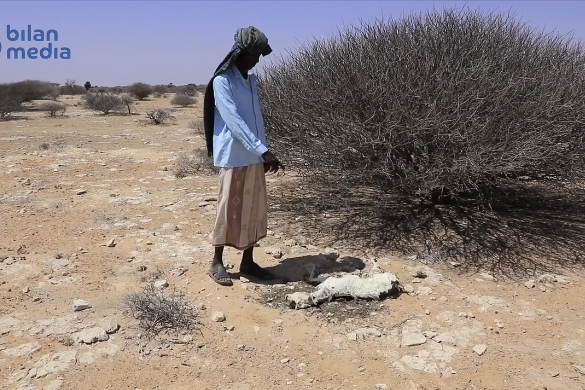
A growing number of pastoralist families in parts of Lower Jubba have begun leaving their homes as a severe drought tightens its grip on the region. The prolonged dry spell has depleted pastureland, dried up water sources, and left livestock weakened, forcing communities to move in search of areas that have received small amounts of rainfall.
Families interviewed say they were compelled to pack up their belongings and relocate to places where they can still find water, grazing land for their animals, and basic food supplies. Many describe the drought as one of the harshest in recent years, warning that both people and livestock are now facing increasing hardship.
In several towns across Lower Jubba, residents have held *roob-doon* prayers, seeking divine intervention amid worsening conditions. Local administrations, religious leaders, and community groups have jointly appealed for urgent assistance for vulnerable households who have lost access to food and water.
Humanitarian concerns continue to rise, as communities fear the situation may deteriorate even further in the coming weeks if no rainfall occurs. With grasslands drying up rapidly and water points shrinking, families say they may be forced to travel even longer distances, especially since the nearest wells are becoming increasingly difficult to reach.
Authorities and aid organizations are being urged to scale up emergency support to prevent a deeper crisis and to assist families whose livelihoods depend entirely on livestock and seasonal rains.
The Minister of Information for Somaliland, Ahmed Yasin Sheikh Ali Ayaanle, has announced his resignation following deadly clashes in Borama that left several people dead. The unrest erupted after the minister allowed a controversial Heer Isse event, sparking widespread protests in the city.
Minister Ayaanle, who remained absent from public view during the two days of protests, said the decision to permit the event was ultimately the responsibility of the President, who had authorized the controversial approval. “I cannot take responsibility for a decision that brought harm to my family and region; it was the President who sanctioned and communicated it,” the minister said.
He described the President as generous for allowing him to work alongside him and expressed gratitude for the cooperation during his tenure. Minister Ayaanle added that he submitted his resignation letter to the President today, which was accepted, and both prayed for the nation’s welfare.
The outgoing minister also addressed the people of the Awdal region, urging them to maintain peace and avoid further clashes with neighboring communities. “You have every right to protest, but avoid actions that can be exploited by adversaries or leave a dark mark in history,” he advised.
The situation in Borama has reportedly stabilized after President Abdirahman Mohamed Abdillahi suspended the Heer Isse event. A reconciliation meeting is scheduled for the 10th of the month to address the grievances of local communities.
However, the Isse clan has expressed dissatisfaction with the government’s decision and insists that the event proceed as planned.