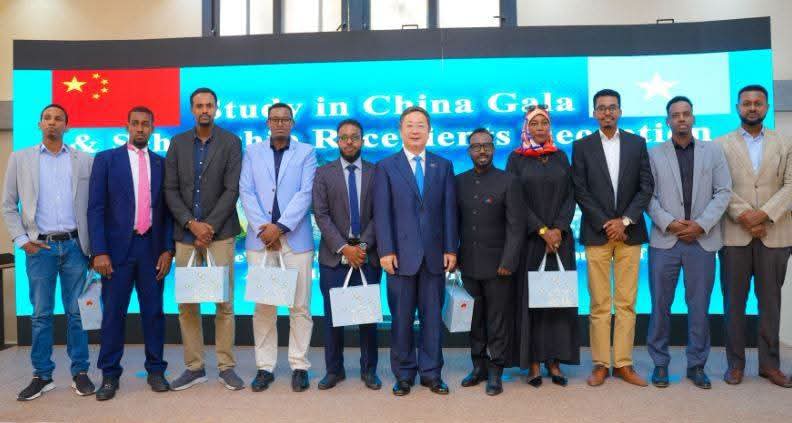
More than 150 Somalis have been awarded Chinese government scholarships this year, the largest cohort so far, as China expands education and professional training opportunities for Somali students, government officials, military officers and other public-sector personnel.
Chinese Ambassador to Somalia Wang Yu announced the figure at a Study in China Gala and Scholarship Recipients Reception in Mogadishu on Sunday, saying both the number of scholarship recipients and Somali personnel admitted to Chinese military training programmes had reached record levels for a second consecutive year.
The reception brought together scholarship recipients, Somali government officials, military representatives, educators and alumni of Chinese universities, highlighting the expanding scope of educational cooperation between the two countries.
Wang said the embassy was holding the joint civilian and military reception for the second consecutive year, reflecting what he described as the broadening of Somalia-China cooperation.
Mohamed Osman Omar, a federal lawmaker and minister at the Ministry of Family Affairs and Human Rights Development, said the scale of the programme had grown sharply since its resumption.
The first group to receive scholarships after the programme restarted consisted of 16 Somali students, compared with more than 150 recipients this year.
He urged the new recipients to make full use of their opportunity and return with skills that could contribute to Somalia’s development.
The Chinese ambassador similarly encouraged the students, many of whom will be travelling to China for the first time, to engage with Chinese society, focus on their studies and build relationships with people they meet.
WIDER TIES
The scholarships form part of a broader expansion of Somalia-China relations, which date back to 1960, when Somalia became one of the first African countries to recognise the People’s Republic of China.
Wang said bilateral cooperation had expanded in recent years across education, trade, infrastructure, humanitarian assistance and security.
He pointed to a protocol signed last month establishing inspection and quarantine requirements for Somali aquatic products entering China under a zero-tariff arrangement, saying further Somali products would eventually benefit from the preferential access.
China has also supported several development and humanitarian initiatives in Somalia, including assistance for the Somali diaspora centre, the National Leaders Academy and a new House of the People office building, Wang said.
He added that China had provided $3 million in humanitarian cash assistance since the end of last year and emergency food aid worth 15 million yuan ($2.1 million) to support Somalia’s response to drought, with another consignment worth 10 million yuan being prepared.
The reception also showcased Somali students already studying in China, illustrating how the scholarship programme is extending beyond conventional academic training.
Hassan Abdulkadir Hashi, a student at Beihang University in Beijing, was recognised for academic achievement and for leading a team that won a prize in the Beijing regional round of the China International College Students Innovation Competition.
Other Somali students featured in presentations included recipients of awards in aerospace engineering, while videos showed Somali medical students receiving clinical training in Chinese hospitals.
The programme also highlighted Somali military officers who have graduated from defence institutions in China, including the International College of Defence Studies at the National Defence University in Beijing.
For scholarship recipient Sowdo Abdulkadir Ali Hure, the path to China began with a preparatory Chinese-language course at Tongji University in 2020.
The COVID-19 pandemic meant she studied remotely from Somalia for more than two years before travelling to China in November 2022.
She later completed clinical medical training and is now preparing to return to China for a master’s degree in ophthalmology.
Her experience was presented at the reception as an example of how the scholarship programme can develop specialised skills that Somalia needs as it rebuilds its institutions and professional workforce.
The growing number of recipients reflects a deeper phase of Somalia-China cooperation in which scholarships and professional training are increasingly being linked to the country’s longer-term development needs.
For Somalia, the challenge will be to ensure that graduates return and find opportunities to apply the skills acquired abroad in sectors ranging from medicine and engineering to public administration, defence and education.